March was the first month of the year in the Roman era. The beginning of this first month, there were many religious celebrations in honor of the turning of the new year (the goddess Anna Perenna), the god Jupiter (leader of the pantheon and known as Zeus to the Greeks) and Mars (the god of war and namesake of the month). Roman battles and campaigns even into the late Imperial period were often ceremonially begun in March on the Field of Mars outside of Rome.
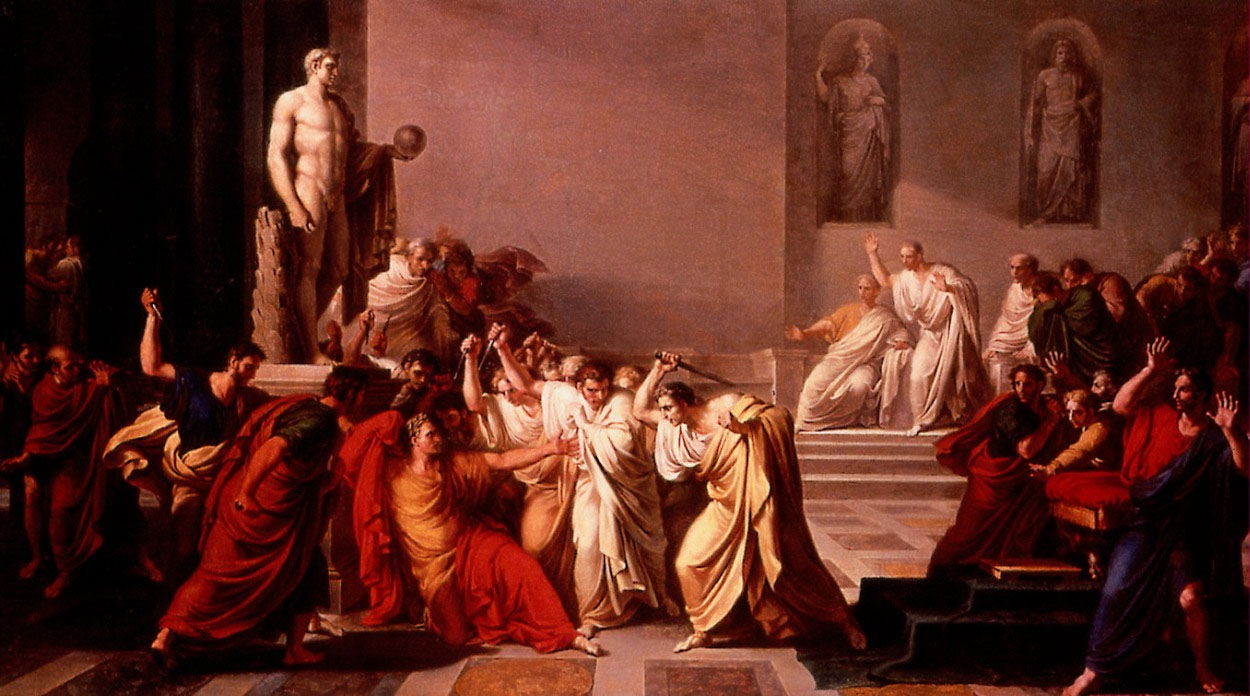 | ||
| The Death of Caesar (1798) by Vincenzo Camuccini |
Plutarch and Suetonius tell readers that a seer named Spurinna warned Caesar that he would be murdered by the Ides of March. Caesar, being the typical, over-confident politician, did not heed Spurinna's warnings. He continued to go about business as usual, including going to an alternate location for the Senate meeting. That day the Senate met at the Theater of Pompey rather than in the Senate House in the Forum. Caesar was murdered in front of the Theater of Pompey in front of a statue of Pompey. The assassination was led by a group of Senators led by Brutus and Cassius.
 |
| Coin minted by Brutus in 42 BCE |
When we went to Rome and toured the Forum in 2009, I visited the altar to the Divine Julius where modern people continue to bring flowers and signs and light candles in honor of Julius Caesar. The altar is in a small, cave-like structure which was fairly dark. I also got to visit the Senate House which is huge and imposing.As a modern visitor I felt the immensity of the building and the immensity of all that had occurred there. There was still a feeling of honor to the building. There is a definite contrast in the feel of the two reconstructed locations that are just yards from each other (in their original locations).
Most people know of the Ides of March from Shakespeare's play Julius Caesar. (I read it in high school.) Shakespeare retells this story in the climax of this play and has Caesar utter the now (in)famous words "Et tu, Brute?". Shakespeare's Caesar is shocked and appalled that Brutus, his political ally and friend, would literally stab him in the back. Caesar cries, "And you, Brutus?" - do you, my friend, even dare to stab me? Do even you want me dead?
All in all, the Ides of March is a pop-culture intro into the mind of many Classicists and Latinists (people who study Rome rather than Greece). Beware the Ides, for the ides have come, but they are not gone!
Resources and References:
Primary Sources
Cassius Dio 48Plutarch, Parallel Lives,The Life of Julius Caesar
Suetonius, Divus Julius
Suetonius, Life of Augustus
Secondary Sources
Shakespeare, Julius CaesarWikipedia article: Ides of March
Images (Courtesy Wikipedia)
Death of CaesarIdes Coin
